The year 2026 marks the beginning of the 15th Five-Year Plan and is a crucial period for advancing people-centered new urbanization and accelerating the comprehensive green transformation of economic and social development, among other key tasks. The outline of the 15th Five-Year Plan proposes to "efficiently utilize urban underground space." Currently, China's urban development is transitioning from large-scale incremental expansion to improving quality and efficiency in existing areas. The strategic importance and practical value of underground space are rapidly increasing, making it a critical carrier for enhancing urban resilience, expanding development space, and serving national strategies.
Recently, the "Jintai Roundtable" themed "Seeking New Momentum: Illuminating Underground Space" was held in Beijing, jointly organized by the People's Daily Online Financial Research Institute and the Underground Space Development Strategy Committee of the Chinese Society for Development Strategy Studies. Academician Xiangsheng Chen, a member of the Chinese Academy of Engineering, Dean of the College of Civil and Transportation Engineering, Dean of the Underground Polis Academy of Shenzhen University, and Chairman of the International Forum on Underground Space (IFUS), was invited. He engaged in in-depth discussions and offered constructive suggestions with representatives from government, industry, and academia on promoting the high-quality development of underground space, drawing from practical work experience.
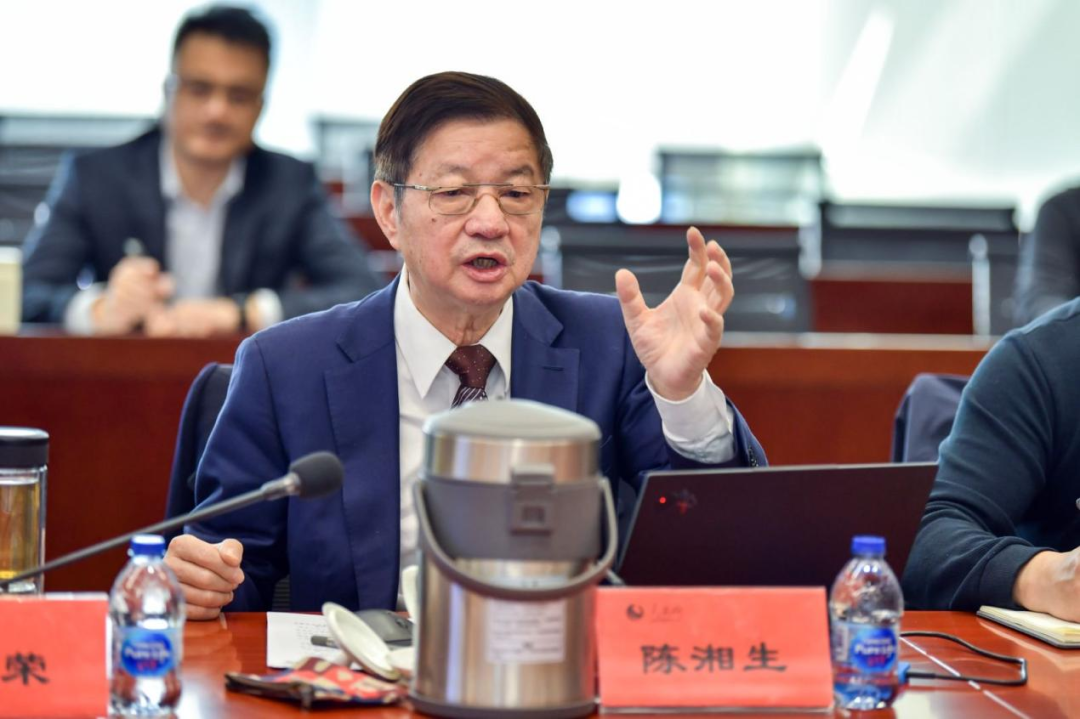
In his speech, Academician Chen Xiangsheng pointed out:
What is the fundamental purpose to develop and utilize underground space? The answer should be clear, i.e., for national territorial security and people's well-being.
Without the security of national territorial space, there can be no stability in urban operations; without the scientific and orderly development and utilization of underground space, it is difficult to support the high-quality development of modern cities. For underground space, safety is not an additional condition but a primary prerequisite; planning is not an afterthought but a form of source governance.
First, it is essential to adhere to integrated planning of above-ground and underground spaces. Underground space is irreversible. Once development and construction are completed, subsequent adjustments are costly, difficult to correct, and may even impact decades of development. Therefore, scientific planning of underground space must be based on integrated planning of above-ground and underground spaces, focusing on the development needs of cities over the next ten, twenty, or even longer periods. Key elements such as lifeline projects, strategically reserved spaces, and emergency response spaces should be prioritized and coordinated, with clear boundaries established for both safety and development. For major infrastructure, important public spaces, sensitive areas, and high-risk zones, it is imperative to follow the principle of planning first, construction second, and coordination first, implementation second. Only by establishing a solid "baseline" can the development of underground space truly be orderly, efficient, and sustainable.
Second, digital means should be employed to enhance the planning and governance capabilities of underground space, promoting the construction of a truly "transparent city." With the continuous advancement of technologies such as digital twins, simulation modeling, artificial intelligence, and BIM, the conditions are now in place for large-scale three-dimensional transparent planning, refined management, and dynamic monitoring. For the development and utilization of underground space, digitalization should not merely serve as a display tool but should become the foundational support for planning and design, engineering construction, operation and maintenance, risk warning, and renovation. It is crucial to establish a unified technological foundation, data standards, and application framework as soon as possible to avoid redundant investments, fragmented development, and isolated systems. Particularly at the national level, greater efforts should be made to strengthen coordination and guidance, promoting the formation of more universal and scalable foundational platforms and technical standards. This will ensure that limited resources are directed toward critical planning, scenarios, and capacity building, truly empowering urban governance.
Third, underground space governance should be elevated to a "whole-life-cycle" approach. From the outset, planning should be guided by the "whole-life-cycle" concept, improving the management of transitions between construction and operation. Requirements for later-stage operation and maintenance, safety monitoring, renovation, and emergency response should be integrated into the planning and construction phases. Key considerations, such as where sensing devices should be installed, which facilities require warning thresholds, and which areas must have rapid response and coordinated mechanisms, should be clearly defined in the early stages of institutional design to genuinely enhance the efficiency of underground space development and utilization.
Furthermore, the renewal of old urban areas should be integrated with underground space governance. Through systematic thinking in underground space governance, existing facilities, pipelines, and underground structures should be analyzed on a unified platform to provide a basis for in-situ upgrades, relocation and reconstruction, and phased renovations. For old urban areas, underground space is not merely incremental space but a crucial tool for improving safety, enhancing urban functions, and elevating public service levels. Only by integrating underground space renewal with the overall deployment of urban renewal can policy support be effectively translated into governance outcomes.
Underground space governance should draw insights from mature practices. Shenzhen has developed relatively mature practices in secondary development, rights confirmation, term management, and full-process supervision of metro projects. Particularly for diverse investment entities such as private and collective investors, clear rights and responsibilities and closed-loop procedures have effectively addressed the complexities of underground space ownership and the lengthy operational chains. Meanwhile, management experiences from Hong Kong in safety systems, process control, and quality systems, as well as explorations in Canada, France, and Tokyo regarding investment and underground land acquisition, offer valuable lessons. The key lies in adapting these experiences to China's national conditions, improving overall planning guidance with a focus on national security, and translating these insights into unified rules and governance capabilities.
Underground space can either serve as a critical foundation for urban safety and resilience or become a neglected source of risk. It is essential to adopt a nationwide, coordinated approach, emphasizing safety as the bottom line, planning as the guide, digitalization as the support, and collaborative governance, ensuring that underground space better serves the construction of modern, people-centered cities.
Source: People's Daily Online
(http://828.people.com.cn/n1/2026/0330/c447981-40691653.html)

 Eng
>
Research
>
Research Highlights
>
Content
Eng
>
Research
>
Research Highlights
>
Content